
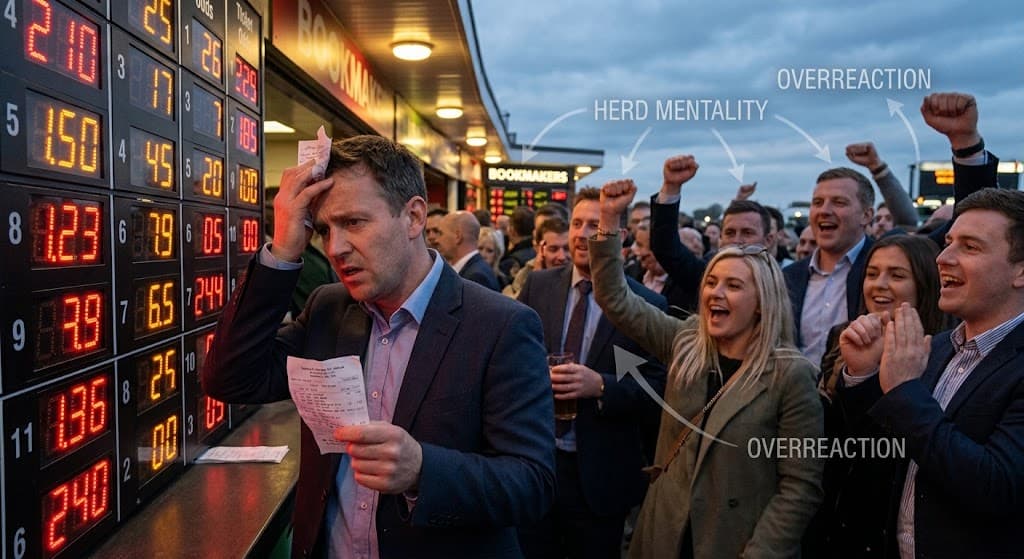
The Wisdom and Folly of the Crowd
The starting price (SP) in horse racing is generally a highly efficient representation of probability. Over a large enough sample size, horses that go off at 2/1 win approximately 33% of the time. However, the market is not perfectly efficient. It is driven by human beings, and human beings are susceptible to cognitive biases.
These biases create systemic market inefficiencies that quantitative models are designed to exploit. By understanding why the public bets the way they do, we can systematically take the other side of their irrationality.
Recency Bias and the Overreaction Effect
One of the most prevalent biases in racing is Recency Bias. The public places disproportionate weight on a horse's most recent run. If a horse won by 5 lengths in its last start, it will likely be heavily overbet in its next race, even if that win occurred under perfect conditions that are unlikely to be replicated today.
Conversely, if a brilliant horse had one poor run due to a bad trip or an unsuitable surface, the public will abandon it. Our Machine Learning models analyze a horse's entire body of work, weighing long-term baseline metrics heavily against single-race variance. We frequently find extreme value by backing quality horses returning from a single, excusable poor performance.
The Jockey and Trainer "Tax"
The betting public loves famous names. Horses ridden by champion jockeys or trained by high-profile stables consistently go off at shorter odds than their raw data justifies. This is the "Jockey Tax."
Our models operate entirely without emotion or name recognition. If an unheralded trainer enters a horse with superior speed figures and a better pace setup against a heavily backed horse from a mega-stable, our algorithm will unhesitatingly flag the unheralded horse as the value play. By systematically avoiding the public's emotional attachments, we capitalize on the mathematical reality.