
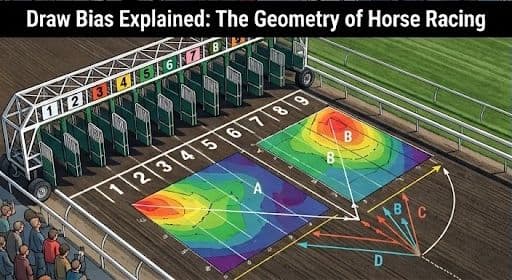
The Mathematics of the Bend
In races run around bends, the geometry of the track dictates that horses running on the inside rail cover less distance than those running wide. In a tightly contested race, the extra ground covered by a horse caught three-wide on the turn is often mathematically insurmountable.
The starting position (the draw or post position) determines how likely a horse is to secure that advantageous inside run. At some tracks, a low draw is an absolute necessity for victory.
Pace and Draw Interaction
However, analyzing the draw requires more than just knowing whether high or low numbers are historically favored. The draw must be analyzed in conjunction with the pace scenario. A horse drawn low with no early speed might get hopelessly trapped behind horses on the rail, rendering the "good" draw a disadvantage.
Our machine learning models synthesize the draw with the projected Pace Map. If a horse with elite early speed is drawn well, its probability of an easy wire-to-wire victory skyrockets. If a deep closer is drawn wide, the Machine Learning calculates the likely ground loss and adjusts the required closing speed accordingly.
Straight Track Anomalies
Even on straight sprint tracks, draw bias is prevalent. Variations in soil compaction, drainage, or even the location of the grandstand (providing shelter from the wind) can make one side of the track significantly faster.
Our algorithms continuously monitor these micro-biases, adjusting probabilities dynamically. By understanding the geometric and environmental realities of the draw, we eliminate horses with mathematically impossible tasks and focus our capital on those positioned for maximum efficiency.